
Find Property Tax Records in Montgomery County
Montgomery County property tax records are kept by the Revenue Commissioner. The county seat is Montgomery, which serves as Alabama's state capital and fourth largest city.
Montgomery County Quick Facts
Montgomery County Revenue Commissioner
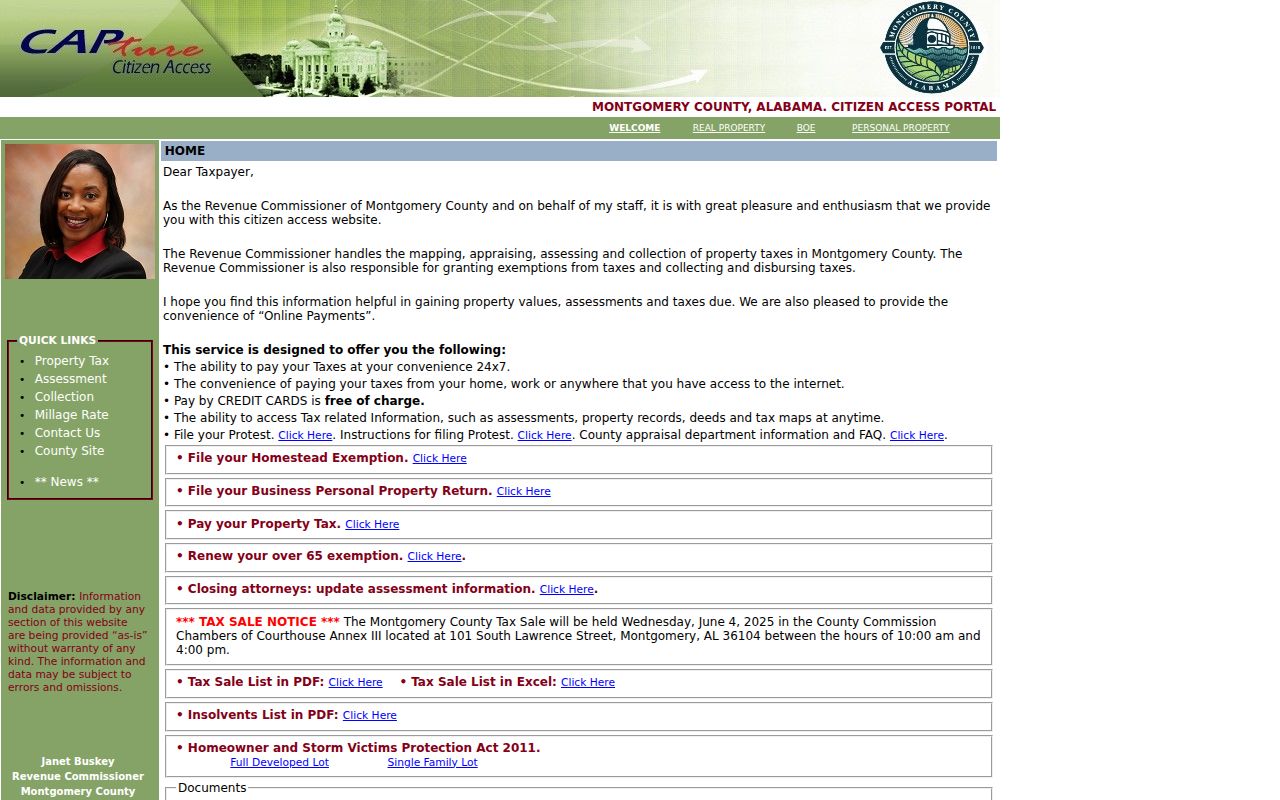
The Montgomery County Revenue Commissioner handles all property tax functions. Janet Buskey serves as Revenue Commissioner. Her office assesses property values, calculates taxes, and collects payments. Montgomery County is one of the larger counties in Alabama with about 100,000 parcels. The main office has moved to a new location on Washington Avenue.
The Revenue Commissioner maintains detailed records on every parcel. Staff can help you find property cards, check tax amounts, apply for exemptions, and set up payments. The office serves both city and county residents. Whether your property is inside Montgomery city limits or in a rural area, this is where you handle property taxes.
| Office | Montgomery County Revenue Commissioner |
|---|---|
| Commissioner | Janet Buskey |
| Address |
125 Washington Avenue Montgomery, AL 36104 |
| Phone | (334) 832-1303 |
| Hours | Monday through Friday, 8:00 AM to 5:00 PM |
| Website | montgomery.capturecama.com |
Search Montgomery County Property Records Online
Montgomery County provides free online access to property records. Visit montgomery.capturecama.com to search any parcel. You can look up properties by owner name, street address, or parcel number. The system shows property details, assessed values, and tax information without needing an account.
The online portal is comprehensive. Search results show all matching properties. Click on one to see the full property card. You can view land size, building details, value history, and current taxes. The site also offers GIS mapping with aerial photos and property lines.
Montgomery County's online system shows:
- Owner name and mailing address
- Property address and legal description
- Parcel number and map reference
- Land acreage and lot dimensions
- Building square footage and features
- Year built and construction type
- Market value and assessed value
- Tax district and millage rates
- Current taxes owed
- Exemptions applied
- Sales history when available
You can print property cards and records from the website. The GIS mapping feature helps you explore areas visually. Click parcels on the map to see info. Montgomery County updates the data regularly to reflect current assessments and ownership.
Montgomery County Property Tax Rates
Property tax rates in Montgomery County include state, county, school, and city taxes. Alabama charges 6.5 mills statewide. Montgomery County adds millage for schools and county services. The City of Montgomery adds city taxes. Your total depends on where your property is located and which taxing bodies apply.
Assessment rates follow Alabama law. Homes are assessed at 10% of market value. Commercial and industrial property is 20%. Farm and timber land is 10% and may qualify for current use valuation. The Revenue Commissioner determines the market value and applies the correct assessment rate for each property.
How your tax is figured in Montgomery County:
- Revenue Commissioner appraises property at market value
- Assessment rate applied based on property class
- Exemptions subtracted from assessed value
- All applicable millage rates multiplied
- Result is your annual tax bill
Montgomery has a mix of urban and rural property. Downtown and commercial areas have higher values. Rural land often qualifies for current use. Contact the Revenue Commissioner to find out the exact millage rate on any specific parcel in Montgomery County.
Pay Property Taxes in Montgomery County
Property taxes in Montgomery County are due October 1 each year. The deadline to pay without penalty is December 31. After that, interest and fees begin. The Revenue Commissioner sends tax bills in the fall. Check your mail and pay on time to avoid extra costs.
Montgomery County accepts several payment methods:
- Online through the county payment portal
- In person at the Revenue Commissioner office
- By mail with check or money order
- Drop box at the office
Online payments are convenient and available 24/7. Card payments may have a small processing fee. Check or bank transfer payments may avoid the fee. When mailing, include your parcel number and allow time for delivery. The postmark date determines if you met the deadline.
Late payment consequences in Montgomery County:
- January 1: Interest begins at 1% per month
- Additional collection fees accrue
- After 3 years: Tax lien sale begins
- Property may be sold to recover taxes
If you have trouble paying, contact the Revenue Commissioner. Options may exist to help you catch up before the situation gets worse.
Property Tax Exemptions in Montgomery County
Montgomery County residents can apply for several exemptions. The homestead exemption reduces taxes on your primary residence. It removes up to $4,000 from the assessed value before taxes are calculated. Apply at the Revenue Commissioner office with your deed and ID. The exemption stays active as long as you live in the home.
Seniors age 65 and older get significant tax relief. The senior exemption removes all state property tax and may reduce county taxes. Disabled homeowners qualify for similar benefits. Veterans with a service-connected VA disability have their own exemption program.
Exemptions available in Montgomery County:
- Homestead: Up to $4,000 off assessed value
- Senior (65+): No state tax, may lower county
- Disability: Similar to senior exemption
- Veteran: Based on VA disability rating
- Current use: Farm, timber, or wildlife land
- Historic property: For qualifying structures
Apply by December 31 for the following tax year. New homeowners should apply soon after buying. The Revenue Commissioner staff can explain each program and help you get all exemptions you qualify for in Montgomery County.
Appeal Property Values in Montgomery County
You can challenge your property value if you think it is too high. Start by contacting the Revenue Commissioner office. Staff can review your property data and fix errors. Wrong measurements, incorrect features, or outdated information are common problems. Many issues are resolved at this stage.
If you disagree after the informal review, file a formal appeal. The Montgomery County Board of Equalization hears these cases. You present evidence, and the board decides if the value should change. Bring recent sales of similar properties, a professional appraisal, or photos showing problems with your property.
Appeal process in Montgomery County:
- Review your assessment notice carefully
- Contact Revenue Commissioner with questions
- Request informal review of property data
- File formal appeal if still in disagreement
- Attend Board of Equalization hearing
- Present your evidence
- Receive the board's decision
- Further appeal to circuit court if needed
The appeal window is limited each year. Watch for your assessment notice and act fast if you want to dispute the value.
Related Records in Montgomery County
Other Montgomery County offices keep property-related records. The Probate Court records deeds, mortgages, and plats. When property sells, the new deed is filed there. Deed records show ownership history over time. The Probate Court also handles estates that include property transfers.
The Circuit Clerk has court files involving real estate. Foreclosure cases, quiet title suits, and mechanic's liens go through the court. For building permits and zoning questions, contact the City of Montgomery or county planning depending on where the property is located.
As the state capital, Montgomery has many government properties that are exempt from tax. Maxwell Air Force Base and state government buildings do not pay property tax. Private residential and commercial properties near these facilities still pay normal taxes. The Revenue Commissioner can tell you if a specific property is taxable.
Cities in Montgomery County
Montgomery County contains the City of Montgomery, Alabama's state capital. Other communities include Pike Road, which has grown rapidly in recent years. All property taxes are assessed and collected by the county Revenue Commissioner. City residents pay city taxes on top of county and state rates.
Nearby Counties
These counties share borders with Montgomery County. Make sure you know which county your property is in for tax purposes.